

Umbraco CMS
WHY USE UMBRACO CONTENT MANAGEMENT SYSTEM?
Umbraco is the only open-source, best of breed CMS for composable DXP (digital experience platform) solutions on the .NET platform. Fully customizable and supports enterprise integration and scalability.

An award winning CMS
Umbraco has won many awards including:

First place in the CMS category for The Visual Studio Magazine 2020 Reader’s Choice Award.

First place in the CMS category for The Visual Studio Magazine 2020 Reader’s Choice Award.

First place in the "Best Enterprise CMS" category for the CMS Critics’ Awards.

Umbraco was among the 3 final winners of the Future Unicorn Award 2019 by Digital Europe.
First place in the CMS category for The Visual Studio Magazine 2020 Reader’s Choice Award.
First place in the CMS category for The Visual Studio Magazine 2020 Reader’s Choice Award.
First place in the "Best Enterprise CMS" category for the CMS Critics’ Awards.
Umbraco was among the 3 final winners of the Future Unicorn Award 2019 by Digital Europe.
POWERING THE BIGGEST ORGANISATIONS IN THE WORLD









UMBRACO FACTS
Biggest and fastest growing Microsoft .Net based CMS (open source)
+1.000.000 active websites worldwide
More than a decade of history
100+ people work at Umbraco HQ
More than 1,500 partners worldwide
+220.000 active Umbraco community members
300+ add-ons from community
Offices in DK, NL and US
THE FRIENDLIEST, EDITOR-CENTERED USER INTERFACE
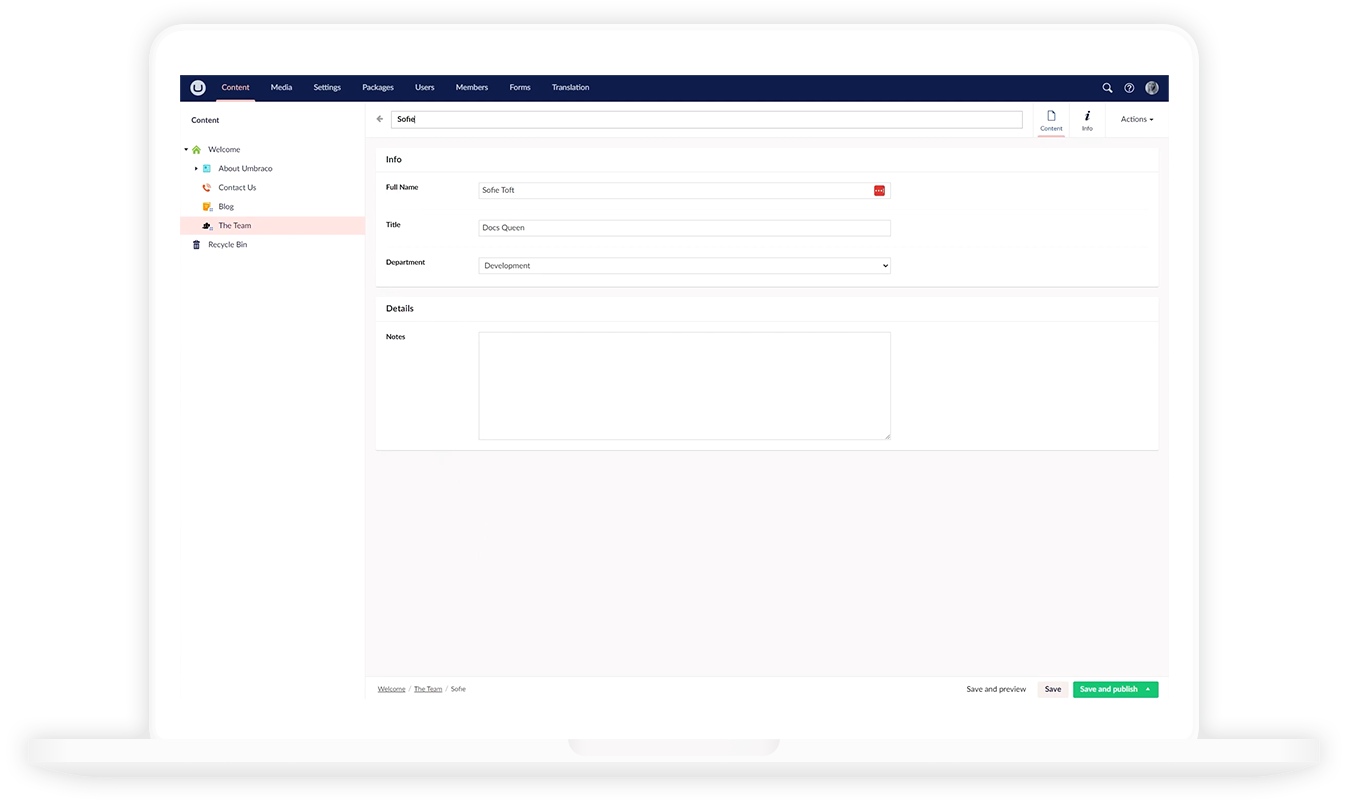
Umbraco CMS is known for its user-friendly, editor-centered interface, making it a top choice for businesses and content teams alike.
Its intuitive design ensures ease of use, allowing editors to focus on content creation without needing technical skills. With features like drag-and-drop functionality and customizable workflows, Umbraco enables efficient content management tailored to each user’s needs. Plus, with expert support from trusted partners like NXT, you’re never alone—help is always within reach. Umbraco CMS offers simplicity, flexibility, and a seamless user experience, making it the ideal platform for managing your online presence.
UMBRACO VS WORDPRESS
Umbraco
- Built on .NET framework (C# strongly typed language) so ultimately more secure and scalable designed for mid-market to enterprise content management with robust compiler reducing potential error risks.
- canvas to develop support complex and market leading creative and page builds. The lightweight frameworks allows simplicity to manage as well as offering complex integration options.
- Supports fully customised design layouts and the latest Version 8+ block/component page builder supports dynamic page building solutions.
- Limited plug and play functionality but no constraints of third party or software integration as flexible code API supports all Martech tools and web components.
- Centrally managed suite of core commercial products aligned with version control and updates to ensure reliability.
Wordpress
- Blogging system that’s evolved into web publishing and built on PHP framework (dynamic language) with known security risks and vulnerabilities and more error prone as a code base.
- Perceived positives of accessibility to plugin marketplace but ultimately over time become a dependency causing a risk of issues from update delays and support, through to security vulnerabilities and site speed limitations.
- Wordpress offers a vast theme selection available to use which again are subject to constraints around the framework and versioning.
- Block editor and content block publishing which is intuitive to use for content publishing but when overly used with too many plugins will cause site speed

SECURITY AND FUTURE OF UMBRACO
Security is at the heart of Umbraco and .NET platform and Umbraco has committed to the future of their CMS. Recently invested in by Monterro (Swedish based growth fund) to support product growth, the backbone on the CMS will always be aligned with free open source. The product itself will be continuous updated and patched. The release schedule is critical for feature growth but also security of the platform and major releases are aligned with those of .NET Core major updates. With the product investing in social coding, cloud hosting, Headless, themed solutions, and marketplace the growth of Umbraco as the primary composable DXP (digital experience platform).
Frequently asked questions
Key Questions About Umbraco and How NXT Delivers Enterprise‑Grade Umbraco Solutions.
Umbraco is the world's largest and most popular open-source .NET CMS — but if you're comparing platforms or trying to understand whether it's right for your organisation, the details matter. These FAQs answer the questions we're asked most often: how Umbraco compares to WordPress, HubSpot, and Optimizely; what it costs; how it's hosted; what it can do with AI; and where its limitations honestly lie. NXT has been an Umbraco specialist since 2012, supporting every major version release, so the answers here come from two decades of hands-on experience.
Umbraco is an open-source content management system built on the Microsoft .NET framework, using C# as its primary programming language. It is the world's largest .NET open-source CMS, powering over one million active websites globally. Organisations using Umbraco include JP Morgan Chase, McDonald's, Sony, Carlsberg, Microsoft, Mercedes-Benz, the Council of the European Union, and the New Zealand Government. Umbraco is maintained by Umbraco HQ with offices in Denmark, the UK, Netherlands, and the United States.
Umbraco and WordPress serve different markets. WordPress is a PHP-based blogging platform that has evolved into a general web publisher; its plugin ecosystem introduces dependency risks, security vulnerabilities, and site speed limitations over time. Umbraco is a .NET-based enterprise CMS designed from the ground up for mid-market to enterprise content management. It offers stronger security by default, a more controlled development environment, no plugin dependency risks, and enterprise-grade multi-site and multilingual management. For organisations where the website is a business-critical asset, Umbraco is the more appropriate long-term choice.
Umbraco and WordPress serve different markets. WordPress is a PHP-based blogging platform that has evolved into a general web publisher; its plugin ecosystem introduces dependency risks, security vulnerabilities, and site speed limitations over time. Umbraco is a .NET-based enterprise CMS designed from the ground up for mid-market to enterprise content management. It offers stronger security by default, a more controlled development environment, no plugin dependency risks, and enterprise-grade multi-site and multilingual management. For organisations where the website is a business-critical asset, Umbraco is the more appropriate long-term choice.
HubSpot CMS is a proprietary, SaaS-based platform primarily designed for marketing-led websites tightly integrated with HubSpot's CRM and marketing automation tools. It is well-suited to teams already fully embedded in the HubSpot ecosystem. Umbraco is an open-source .NET CMS designed for greater customisation, enterprise-scale content management, and complex application development. Umbraco integrates with HubSpot via API, giving you the marketing automation capability alongside full ownership and flexibility of the CMS. Organisations with bespoke application requirements or complex integrations typically find Umbraco significantly more capable.
Both Umbraco and Optimizely are .NET enterprise CMS platforms. Optimizely is a commercial, proprietary platform with higher licensing costs, typically positioned at large enterprise and e-commerce organisations requiring advanced personalisation and A/B testing as built-in features. Umbraco is open-source with no licensing cost for the core CMS, making it more cost-effective for mid-market organisations. Umbraco supports personalisation and testing through third-party integrations, while Optimizely bundles these features natively. For organisations without a specific Optimizely requirement, Umbraco provides comparable enterprise capability at significantly lower cost.
Umbraco's architecture is deliberately unopinionated — it provides a content management framework rather than a fixed system, meaning developers can build any front-end, data structure, or integration without platform constraints. Its flexible API supports all standard Martech tools and web components. The block and component page builder supports dynamic page building without the plugin dependency risks of WordPress. As a .NET platform, Umbraco also inherits the full Microsoft Azure integration ecosystem, giving enterprise organisations cloud-native infrastructure options.
Umbraco integrates with AI systems through its flexible API architecture. NXT has deployed AI agents within the Umbraco back-office for: automated content tagging and classification, multilingual translation with tone preservation, publishing pipeline automation, on-demand analytics and KPI reporting, personalised content delivery based on visitor behaviour, and customer service chatbot integration. Umbraco's modular content architecture makes it well-suited to AI augmentation because content is structured as discrete, queryable data rather than monolithic page HTML.
Umbraco can be hosted on any Windows or Linux server environment compatible with .NET. The most common enterprise hosting options are Microsoft Azure (App Services or Virtual Machines), AWS, and Umbraco Cloud (the managed SaaS hosting option provided by Umbraco HQ). NXT recommends Azure for most mid-market and enterprise clients due to its deep .NET integration, global CDN, Azure Security Centre, and compliance certifications. NXT manages Azure infrastructure on behalf of clients as part of its managed hosting retainer.
Umbraco CMS is a flexible and powerful platform, but like any CMS, it’s designed with a particular approach in mind. Because Umbraco is built on modern .NET technologies, customisation and advanced functionality are typically handled by experienced .NET developers. This supports high-quality, scalable solutions, though it does mean builds are usually more tailored rather than “off-the-shelf.” Compared to platforms like WordPress, Umbraco has a more curated ecosystem of packages. While there are many excellent extensions available, projects are less reliant on plug-and-play plugins and more focused on clean, maintainable builds. As a result, initial implementations can involve more upfront planning and development. However, this approach often leads to greater long-term stability, performance, and flexibility as digital requirements evolve.
