
AI Agent Development Services
Our development team builds, trains, and deploys custom AI agents across industries.
Our development team builds, trains, and deploys custom AI agents across industries. We integrate them into your Umbraco CMS, bespoke applications, or third-party platforms—transforming business processes.
Recent examples include:
- Prompt Engineering – Smart-prompt sequences, step-by-step workflows, and context-aware queries supporting specific business objectives within an application.
- Umbraco Back Office Agents – Automate content tagging, publishing pipelines, and version control.
- Multilingual Translation Agents – Real-time localisation with industry-grade translation APIs and tone preservation.
- Reporting & Analytics Agents – Generate custom dashboards, KPI reports, and insights on demand.
- Customer Service Agents – 24/7 chat and voice assistants with escalation logic and sentiment analysis.
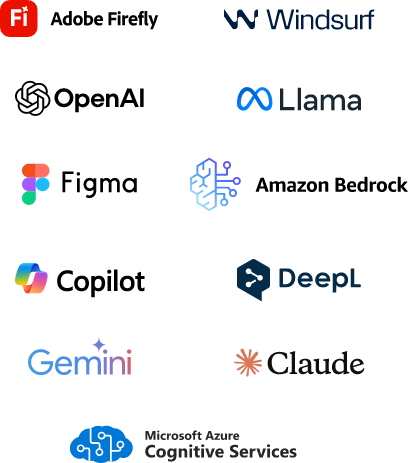
- API & Integration Development – Connect OpenAI, Anthropic Claude, Gemini, Microsoft Copilot, and proprietary models.
- Search Agents – Design, implement and query internal datasets for customised results and reporting.
Ready to build your AI-powered future? Contact our team or visit our Insights and Case Studies pages to learn more.
Frequently asked questions
Essential Questions About NXT’s AI Strategy, Platforms, and Real‑World Use Cases.
AI is moving fast — and the practical questions around it are moving just as quickly. These FAQs cut through the noise to explain what AI agents are, how NXT plans and builds them, which platforms and models we work with, and what real-world use cases look like for marketing and communications teams. If you're considering AI integration but aren't sure where to start, this is the right place.
NXT designs and develops AI agents using: OpenAI API (GPT-4 and successors), Anthropic Claude, Google Gemini, Microsoft Copilot, Microsoft Foundry and more. For clients with specific data residency, performance, or cost requirements, NXT also builds integrations with proprietary or custom LLMs. Model selection is based on use-case fit, not commercial preference.
NXT has delivered AI agents for: automated content tagging and CMS publishing pipelines, multilingual translation with tone preservation, customer service chat and voice assistants with escalation logic, on-demand KPI reporting and analytics dashboards, email automation and lead nurturing integrations, HubSpot and Workday data workflows, and internal dataset search agents. Each agent is scoped to a defined business objective with measurable ROI.
NXT builds AI agents that operate directly within the Umbraco back-office, automating tasks such as content tagging, publishing pipeline management, version control, and multilingual localisation. Agents can also connect Umbraco to external systems — including CRM, analytics, and translation APIs — creating end-to-end automated workflows that reduce manual editorial effort without replacing human oversight.
NXT's AI planning process starts with objectives and use-case identification — understanding which specific tasks should be automated or augmented and why. This is followed by a data and integration audit, assessing existing systems (CRM, CMS, analytics tools) for agent compatibility. From there, NXT produces a technology roadmap recommending the appropriate model and infrastructure, with defined KPIs, A/B testing plans, and a reporting framework to measure success.
AI-generated content performs best as an augmentation tool rather than an autonomous author. NXT configures AI agents with brand guidelines, tone of voice parameters, and content constraints before any output reaches an editor. This ensures outputs are consistently on-brand. Human editorial review remains part of the workflow — the agent handles volume and repetitive tasks, freeing the team to focus on strategy and judgement-led work.
NXT's AI agent deployments include a security and compliance review covering infrastructure configuration, data governance, privacy controls, and access management. Agents are scoped to access only the data they require. For clients handling personal data, NXT ensures AI workflows comply with UK GDPR requirements, including data minimisation, processing agreements, and audit logging.
An AI agent is a self-contained software system powered by a large language model (LLM) that can reason, plan, and take actions across multiple systems — not just respond to predefined questions. Where a chatbot follows a fixed script, an AI agent can access data from CRM systems, trigger CMS publishing workflows, generate reports, and handle multi-step tasks autonomously. NXT builds, trains, and deploys custom AI agents integrated into Umbraco CMS, bespoke applications, and third-party platforms.
